
Introduction
Extremophiles, microorganisms adapted to survive in environments hostile to most life forms, represent a unique reservoir of robust enzymes, known as extremozymes. These biocatalysts are distinguished by exceptional structural stability, high catalytic efficiency, and remarkable resilience under extreme conditions. Unlike mesophilic enzymes, extremozymes retain activity at elevated temperatures (>60 °C), extreme pH ranges (<4 or >10), high salinity, and elevated hydrostatic pressure, making them indispensable for applications in industrial biotechnology, pharmaceutical manufacturing, environmental remediation, and synthetic biology.
The exploration and utilization of extremophiles have revolutionized enzyme technology, enabling sustainable, high-performance solutions in sectors ranging from food and beverage processing to green chemical synthesis and high-value biopharmaceuticals. By harnessing these naturally optimized biocatalysts, researchers and industries can enhance process efficiency, reduce energy consumption, and achieve chemical transformations under previously inaccessible conditions.
Advances in biotechnology, including metagenomics, protein engineering, and synthetic biology, have transitioned extremozymes from laboratory curiosities to cornerstone biocatalysts in sustainable chemistry. This review synthesizes recent discoveries, underlying mechanisms, engineering approaches, and industrial deployments, underscoring their role in green chemistry, resource-efficient manufacturing, and precision biomedicine.
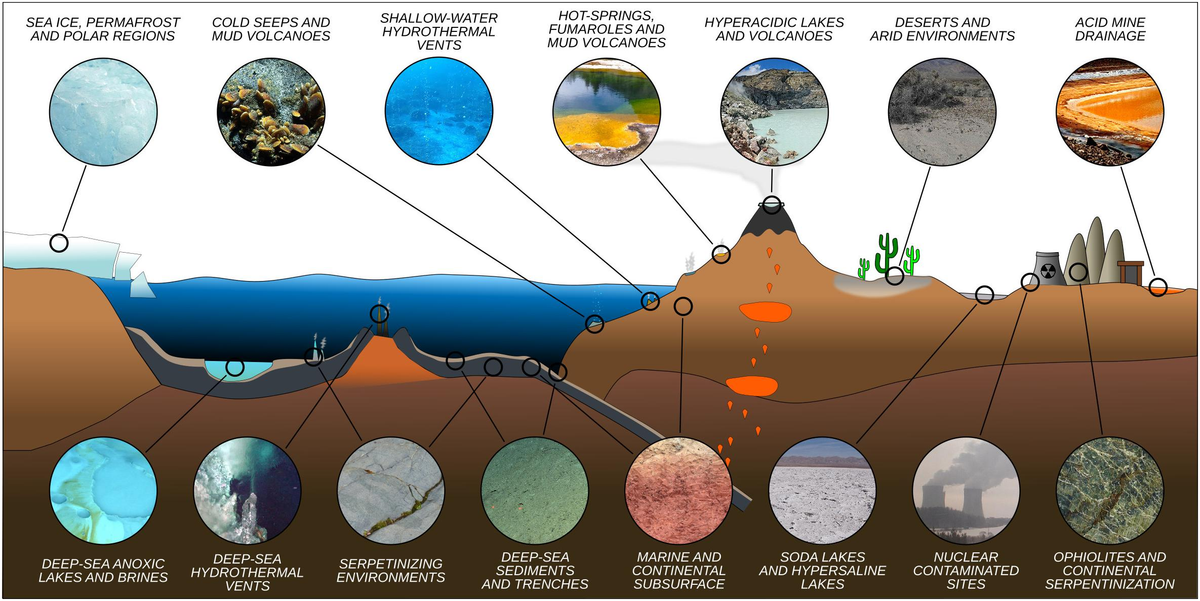
Extreme Environments as Natural Bioreactors
Hypersaline Lakes and Salt Flats Hypersaline habitats (e.g., salt flats and soda lakes) enrich for halophilic archaea and bacteria that produce salt-tolerant enzymes such as proteases, amylases, and lipases. These maintain conformational integrity and catalytic activity in high-ionic-strength media through adaptive surface charge distributions and compatible solute accumulation, enabling biotransformations in saline industrial effluents.
Applications: Halophilic amylases in starch saccharification under saline conditions; proteases for detergent formulations; lipases in high-salt lipid processing. Sampling Insights: Precise in situ measurement of salinity, pH, and temperature during metagenomic sampling ensures preservation of functional genetic material for downstream sequencing and activity-based screening.
Acidic and Alkaline Hot Springs Geothermal springs (pH <3 or >9, >80°C) harbor acidophilic and alkaliphilic microbes yielding pH-resistant hydrolases. Acid-stable enzymes maintain protonated active-site residues for catalysis in biofuel pretreatment and food processing; alkaline proteases enhance detergent performance and non-neutral protein hydrolysis.
Acidic and Alkaline Hot Springs
Geothermal springs (pH <3 or >9, >80°C) harbor acidophilic and alkaliphilic microbes yielding pH-resistant hydrolases. Acid-stable enzymes maintain protonated active-site residues for catalysis in biofuel pretreatment and food processing; alkaline proteases enhance detergent performance and non-neutral protein hydrolysis
Functional Diversity of Extremozymes
Extremozymes display sophisticated structural adaptations that confer operational stability under denaturing conditions:
- Thermostability: Enhanced hydrophobic core packing, increased ion-pair networks, and disulfide bridges minimize unfolding entropy at elevated temperatures.
- Solvent Tolerance: Surface hydrophilicity combined with strategic salt bridges preserves hydration shells in organic media, facilitating non-aqueous biocatalysis.
- Pressure Resistance: Compact folds from piezophilic enzymes withstand high hydrostatic pressures in high-pressure reactor systems.
- pH Adaptation: Titratable residues and stabilized active-site geometry sustain catalysis across broad pH spectra.
These traits collectively expand the operational window of biocatalysis beyond mesophilic limitations.
Protein Engineering and Directed Evolution
Natural robustness of extremozymes is augmented through rational and evolutionary engineering to meet bespoke industrial specifications:
- Rational Design: Crystal structures and molecular dynamics guide site-directed mutagenesis to optimize stability, substrate affinity, and turnover.
- Directed Evolution: Random mutagenesis libraries subjected to iterative high-throughput screening under process-mimicking conditions yield variants with tailored kinetics.
- Chimeric Enzymes: Domain swapping or fusion constructs integrate complementary traits for cascade catalysis.
Industrial Applications
Biopharmaceutical Manufacturing Thermostable extremozymes enable high-temperature enzymatic synthesis of chiral APIs, preserving stereoselectivity and purity. They also stabilize vaccine and therapeutic protein formulations, eliminating cold-chain requirements.
Food and Beverage Processing Thermostable amylases and glucoamylases accelerate starch liquefaction and saccharification in brewing and baking; proteases facilitate cheese ripening, meat tenderization, and protein hydrolysate production. Enzymatic resilience during pasteurization safeguards nutritional integrity and sensory profiles.
Green Chemical Synthesis Solvent-tolerant extremozymes supplant toxic metal catalysts in enantioselective transformations, enabling atom-efficient synthesis of fine chemicals, polymers, and intermediates with minimal energy input and waste.
Environmental Remediation Thermophilic and halo-tolerant hydrolases degrade lignocellulose for second-generation biofuels and treat saline wastewater; accelerated pollutant breakdown supports bioremediation in extreme industrial effluents.
Cutting-Edge Biotechnological Innovations
Extremozymes in Synthetic Biology High-temperature DNA polymerases and ligases underpin cell-free DNA assembly, metabolic pathway engineering, and synthetic genome construction. Non-natural nucleotide incorporation supports DNA nanotechnology and molecular data storage.
Metagenomic Mining Culture-independent approaches bypass cultivation bottlenecks, enabling functional screening of unculturable extremophiles. Bioinformatics integration accelerates discovery of novel catalytic scaffolds.
Computational Design and AI Integration Machine-learning-guided structural prediction and in silico mutagenesis drastically shorten screening timelines, facilitating rapid optimization of processivity and inhibitor resistance.
Future Perspectives
- Hybrid biocatalyst systems for streamlined multi-step transformations.
- Expanded substrate scope encompassing non-natural substrates and modifications.
- Ultra-high-fidelity extremozymes for therapeutic genome editing and precision medicine.
- Seamless integration into circular bioeconomy frameworks for green chemistry and bioremediation.
Conclusion
Extremophiles and their derived enzymes are reshaping industrial biotechnology, pharmaceutical production, food processing, and environmental stewardship. Through synergistic advances in protein engineering, directed evolution, metagenomic exploration, and AI-driven design, extremozymes deliver robust, sustainable, and high-performance solutions for next-generation biocatalysis, advancing global green technology objectives.